
Sacramento fiber cement siding
Fiber Cement Siding Installation in Sacramento, CA: James Hardie Siding Costs, Products, Fire Ratings and Installation Standards
2026 fiber cement and James Hardie siding costs, product lines, HZ10, fire-zone rules and installation standards for Sacramento homes.
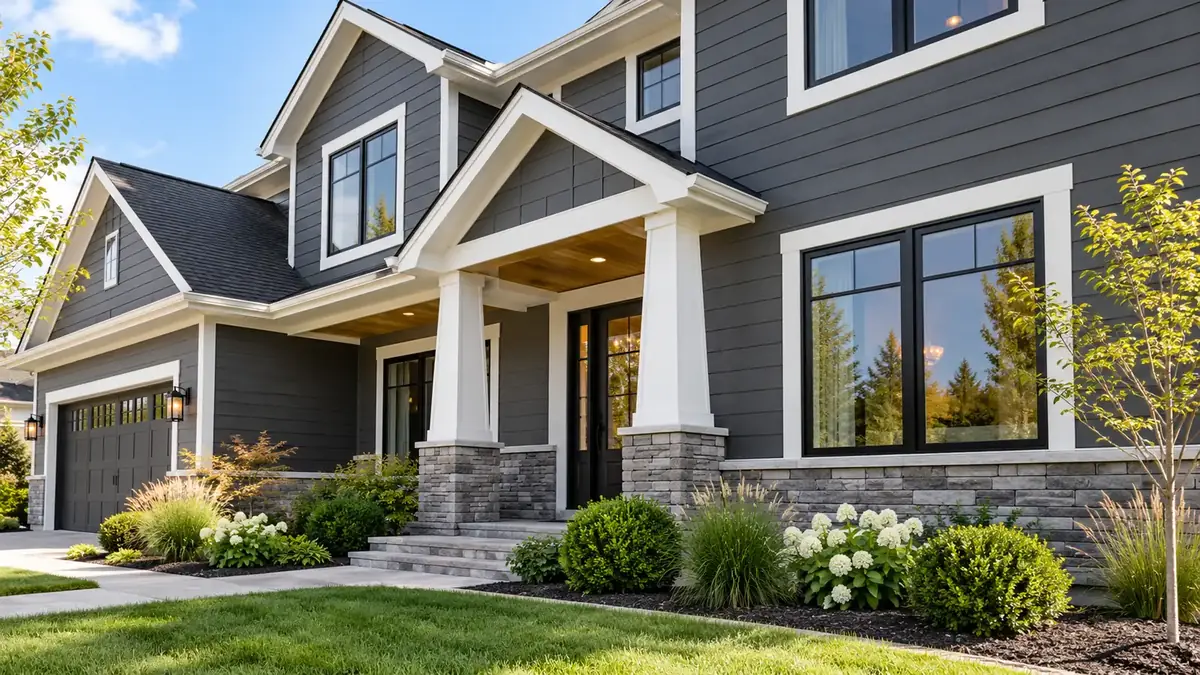
Last updated: November 2, 2026 · Prices are calculated by Sacramento Siding Pros from 2026 local installer rates.
Fiber cement siding installation in Sacramento, CA costs $12–$22 per square foot in 2026, or $30,000–$68,000 or more for a whole-home re-side. Fiber cement siding (Hardie board, cement board siding) is cladding made of Portland cement, sand and cellulose fiber. Sacramento homes use fiber cement siding for 2 local conditions: a noncombustible rating for fire hazard zones and dimensional stability in 100°F+ summers. This page is part of the siding installation in Sacramento guide.
What is fiber cement siding?
Fiber cement siding is exterior cladding made of Portland cement, sand, cellulose fiber and water, pressed into planks, panels or shingles and cured under heat and pressure. James Hardie Building Products is the largest fiber cement brand. Homeowners also call the material Hardie board, HardiePlank, hardy siding or cement fiber siding.
What is Hardie board made of?
Hardie board is made of 4 ingredients: Portland cement, crystalline silica sand, cellulose wood fiber and water. The James Hardie Safety Data Sheet for HZ5 and HZ10 exterior products lists crystalline silica (quartz) at 15–45% and cellulose fiber at under 15% by weight. Intact boards release no dust, while cutting, drilling and sanding release respirable silica.
Is Hardie board the same as fiber cement siding?
Yes. Hardie board is a brand-name synonym for fiber cement siding made by James Hardie. James Hardie’s core siding forms are HardiePlank (lap siding), HardiePanel (vertical siding), HardieShingle (shingle siding) and HardieTrim (trim boards); Table B lists all 6 product lines used on Sacramento homes. Other manufacturers, for example Allura and Nichiha, sell fiber cement siding under their own brand names.
Does modern fiber cement siding contain asbestos?
No. Modern fiber cement siding uses cellulose fiber instead of asbestos. James Hardie switched to cellulose fiber in the mid-1980s and opened its first US fiber cement plant in 1989. Asbestos-cement shingles still cover some 1940s–1970s Sacramento homes. Those shingles are lab-tested for asbestos before tear-off.
What are the benefits of fiber cement siding?
Fiber cement siding has 5 main benefits:
- Fire performance: noncombustible under ASTM E136.
- Heat stability: no softening or warping at Sacramento summer wall temperatures.
- Termite resistance: the cement substrate is not a termite food source.
- Warranty length: 30-year non-prorated, transferable substrate warranty from James Hardie.
- Resale value: 114% of project cost recouped at resale (2025 Cost vs. Value, national).
How much does fiber cement siding installation cost in Sacramento in 2026?
Fiber cement siding installation costs $12–$22 per square foot in Sacramento in 2026, compared with $6–$15 per square foot nationally (HomeGuide). A whole-home fiber cement re-side costs $30,000–$68,000 or more.
Table A shows 2026 installed fiber cement siding cost by wall area in Sacramento and nationally. Rows list wall area, not floor area. Costs include labor and materials in US dollars.
Table A. Installed fiber cement siding cost by wall area, 2026 (calculated by Sacramento Siding Pros from 2026 local rates)
| Wall area | Sacramento installed ($12–$22/sq ft) | National installed ($6–$15/sq ft) |
|---|---|---|
| 1,000 sq ft (10 squares) | $12,000–$22,000 | $6,000–$15,000 |
| 1,500 sq ft (15 squares) | $18,000–$33,000 | $9,000–$22,500 |
| 2,000 sq ft (20 squares) | $24,000–$44,000 | $12,000–$30,000 |
| 2,500 sq ft (25 squares) | $30,000–$55,000 | $15,000–$37,500 |
For floor-area estimates, see siding cost in Sacramento.
Which 5 factors change a fiber cement estimate?
5 factors change a fiber cement siding estimate in Sacramento:
- Finish type: ColorPlus factory-finished boards cost more than primed boards painted on site.
- Tear-off: removing old siding adds $0.70–$2.00 per square foot.
- Story count: 2-story walls require scaffolding or lifts.
- Trim and soffit scope: HardieTrim, fascia and soffit add linear-foot labor.
- Hidden damage: sheathing and dry-rot repair is priced after tear-off.
Material orders also include a 10–15% waste allowance for cuts.
Is fiber cement siding expensive?
Fiber cement siding costs $6–$9 more per square foot than vinyl siding in Sacramento, comparing $12–$22 with $6–$13 at each end of the range. Fiber cement costs $2–$5 more per square foot than engineered wood ($10–$17). Spread over a 30–50-year lifespan, fiber cement costs $0.43 per square foot per year, against $0.32 for vinyl.
Is fiber cement siding worth it?
Fiber cement siding replacement recoups 114% of its cost at resale, based on a $21,485 national average project in Zonda’s 2025 Cost vs. Value Report (113.7% recouped), the latest edition. In Sacramento fire hazard zones, fiber cement siding also meets the noncombustible exterior wall option without added fire-retardant treatment.
Which James Hardie siding products are installed on Sacramento homes?
James Hardie sells 6 siding product lines: HardiePlank lap, HardiePanel vertical, HardieShingle, Artisan, Architectural Panel and HardieTrim with Batten and Soffit.
Table B lists 6 James Hardie product lines by profile, thickness, texture and common use on Sacramento homes. Dimensions come from the James Hardie product catalog.
Table B. James Hardie siding product lines and Sacramento uses
| Product | Profile | Thickness | Textures / sizes | Common Sacramento use |
|---|---|---|---|---|
| HardiePlank | Horizontal lap | 5/16″ | 5.25″–12″ widths × 12 ft; Smooth, Select Cedarmill | Ranch and tract home re-sides |
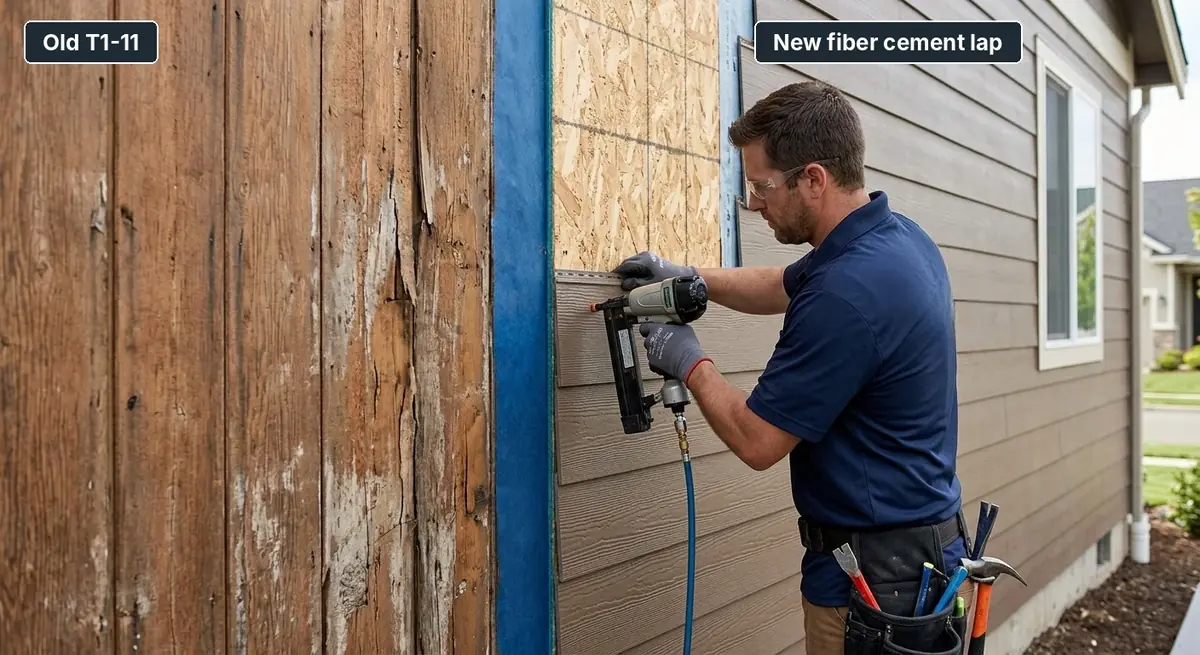
| HardiePanel | Vertical sheet | 5/16″ | 4×8 ft, 4×10 ft; Smooth, Cedarmill, Stucco, Sierra 8 | Replacing T1-11 on 1970s–1990s homes |
| HardieShingle | Shingle | 1/4″ | Straight and staggered edge panels | Gables and Craftsman accents |
| Artisan | Deep-shadow lap | 5/8″ | Primed, smooth | Land Park and East Sacramento remodels |
| Architectural Panel | Modern flat panel | 5/16″ | 4×8, 4×10, 4×12 ft; Fine Sand, Mounded Sand, Sea Grass | ADUs and modern infill homes |
| HardieTrim / Batten / Soffit | Trim, batten strips, soffit | 3/4″ and 1″ (trim) | Smooth, rustic grain | Window trim; board and batten with HardiePanel |
What is HZ10 siding?
HZ10 siding is the James Hardie fiber cement formulation engineered for hot, humid and high-UV climates. HZ5 siding is engineered for freeze-thaw climates and adds a beveled top edge and drip edge. James Hardie’s HZ10 coverage area includes 10 states, Puerto Rico and listed ZIP codes in 10 more states, including California. The California list includes Sacramento (95814), Folsom (95630) and El Dorado Hills (95762) with no elevation limit, so the Sacramento Valley and nearby foothill suburbs use HZ10 products. Some higher-elevation California ZIP codes qualify for HZ10 only below 2,000 feet. James Hardie’s installation instructions require the correct HardieZone product for the address.
What is the difference between ColorPlus and primed Hardie siding?
ColorPlus siding carries a factory-baked finish with a 15-year limited finish warranty, while primed siding is painted on site within 180 days of installation. James Hardie specifies 100% acrylic topcoats for primed boards and excludes stain, oil/alkyd paint and powder coating. The James Hardie Dream Collection offers nearly 700 finish colors. Color options are covered in James Hardie siding colors.
What does the James Hardie warranty cover?
The James Hardie warranty covers the fiber cement substrate for 30 years on a non-prorated basis. The warranty has 4 terms:
- Substrate coverage: 30 years, non-prorated, for siding, trim and soffit.
- Transferability: coverage extends to the first transferee of the home.
- Finish coverage: 15-year limited warranty on ColorPlus finishes.
- Labor coverage: provided by the installer, not by James Hardie.
James Hardie requires written notice, with photos, within 90 days of discovering a defect and before any permanent repair. The warranty excludes damage from improper installation (including not following James Hardie’s published instructions and local building codes), wall-assembly design, water infiltration, structural movement, severe weather and other acts of God, third-party paints and coatings, mold and lack of maintenance.
Which fiber cement siding brands compete with James Hardie?
4 fiber cement brands sell siding in Northern California: James Hardie, Allura, Nichiha and GAF WeatherSide.
Table C compares 4 fiber cement siding brands by product type, thickness, warranty and wildland-urban interface listing. Values come from manufacturer specification sheets and code evaluation reports.
Table C. Fiber cement siding brands sold in Northern California
| Brand | Parent company | Product types | Plank thickness | Substrate warranty | Fire / WUI documentation |
|---|---|---|---|---|---|
| James Hardie | James Hardie Industries | Lap, vertical panel, shingle, trim, architectural panel | 5/16″ | 30-year non-prorated | ASTM E136 noncombustible; WUI listed |
| Allura | Plycem USA | Lap, vertical panel, shapes (shake, shingle), soffit | 5/16″ | 30-year transferable limited | ASTM E136 noncombustible (ICC-ES ESR-1668) |
| Nichiha | Nichiha USA | Architectural wall panels, lap siding (Savannah), shake panels (Sierra Premium) | 1/2″ (Savannah lap) | 30-year limited (Savannah, Sierra Premium); transferable once | OSFM WUI listing 8140-2029:0002 (Sierra Premium, 2025 handbook) |
| GAF WeatherSide | GAF | Cement shingle (Purity, Profile, Emphasis) | Not published | 25-year limited (prorated after year 1) | ASTM E136 noncombustible; WUI listing not published |
The 4 brands differ on 3 neutral criteria: warranty length, wildland-urban interface documentation and local installer availability. GAF WeatherSide matches the size of old asbestos-cement shingles, so WeatherSide fits partial repairs on older Sacramento homes.
How does fiber cement siding perform in Sacramento’s climate?
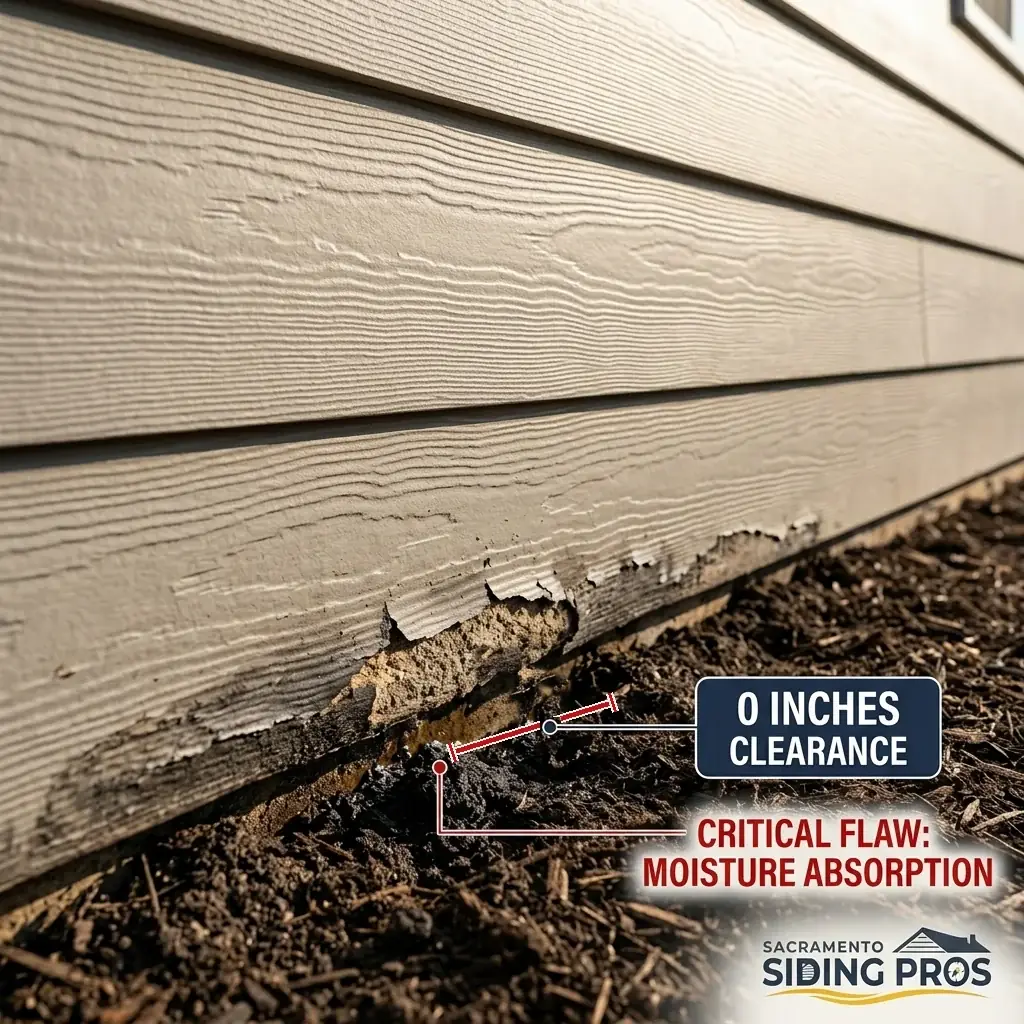
Fiber cement siding stays dimensionally stable in Sacramento’s 100°F+ summers, but fiber cement edges absorb water when clearances or paint fail.
Does fiber cement siding warp in heat?
No. Fiber cement siding does not soften or warp in Sacramento heat. Vinyl siding distorts near 160–165°F, and Sacramento logged a record 45 days at or above 100°F by late September 2024. Fiber cement butt joints are installed in moderate contact, while vinyl siding requires expansion gaps of 1/4″ or more.
Is fiber cement siding waterproof?
No. Fiber cement siding is water-resistant, not waterproof. Board edges absorb water. Installers seal every field-cut edge and install a water-resistive barrier behind the siding. Sacramento receives about 19 inches of rain per year (1991–2020 normal), and lawn sprinkler overspray wets the bottom course in dry months.
Do termites eat fiber cement siding?
No. Termites do not eat fiber cement siding because the cement matrix is not a food source. UC Statewide IPM documents drywood and subterranean termites across California. On a fiber cement home, termite risk shifts to wood trim, sill plates and framing.
How weather resistant is fiber cement siding?
The 30-year James Hardie warranty states that the siding will not be damaged by termites and resists hail damage. The HZ10 formulation is engineered for heat and UV exposure, and ColorPlus finishes add a separate 15-year finish warranty.
Is fiber cement siding allowed in Sacramento fire zones?
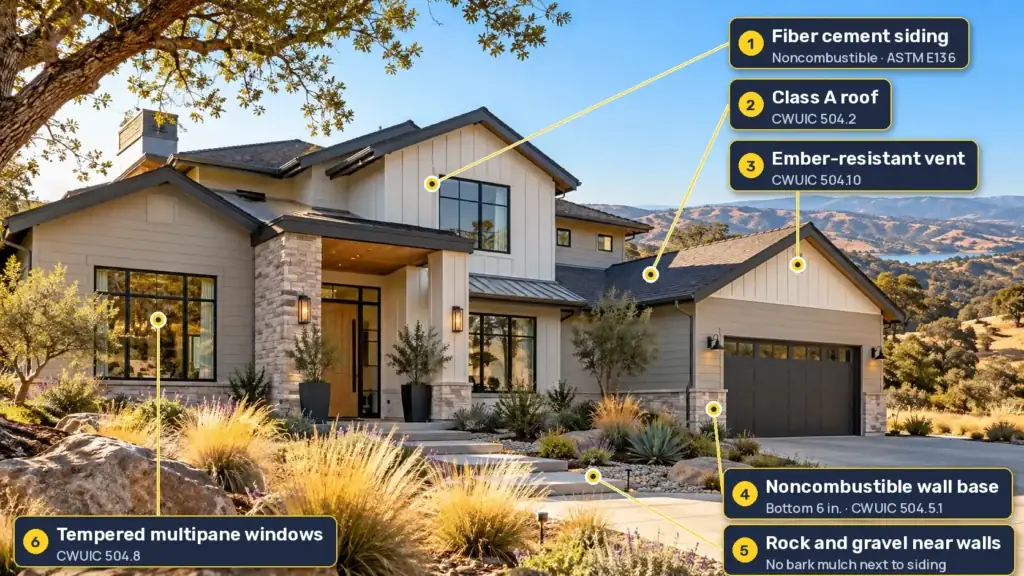
Yes. Fiber cement siding is noncombustible under ASTM E136 and Class A under ASTM E84, so fiber cement qualifies as exterior wall covering in Fire Hazard Severity Zones. James Hardie siding is also used in ASTM E119 fire-rated wall assemblies. The fire rating covers the board, not the paint or caulk.
Which fire code applies to siding in Sacramento?
The California Wildland-Urban Interface Code (CWUIC, Title 24 Part 7) governs siding in Sacramento fire hazard zones as of January 1, 2026. The CWUIC replaced CBC Chapter 7A. Section 504.5 sets exterior wall rules, Section 504.5.2 covers wall covering materials, and Section 504.5.1 requires 6 inches of noncombustible material or metal flashing where walls meet the ground, decks and roofs. On the 2025 OSFM Fire Hazard Severity Zone maps, most of Sacramento County’s zoned land is unincorporated; Rancho Cordova has 11,677 acres in the Moderate zone and Folsom has 5,293 zoned acres. Sacramento Metropolitan Fire District adopted the 2025 map in Ordinance 2025-01 on June 12, 2025.
Does fiber cement siding lower homeowners insurance?
Fiber cement siding helps meet 1 building item in the California Department of Insurance Safer from Wildfires framework: noncombustible material on the bottom 6 inches of exterior walls. The 6 inches are measured from the ground and from attached decks, and the Department lists fiber-cement siding among the accepted materials. Discount amounts vary by insurer. Detailed fire-zone requirements are covered in fire-resistant siding in Sacramento.
How is fiber cement siding installed?
Fiber cement siding installation follows 9 steps:
- Remove the old siding and dispose of debris.
- Repair damaged sheathing and dry rot.
- Insulate opened wall cavities to Title 24 levels: R-13 for 2×4 walls and R-20 for 2×6 walls.
- Wrap the wall in a water-resistive barrier.
- Flash windows, doors and roof-wall intersections.
- Install the starter strip and HardieTrim.
- Blind-nail planks with a 1¼” minimum lap into studs spaced 24″ on center or less.
- Caulk trim joints with ASTM C920 sealant.
- Paint primed boards within 180 days of installation.
Which clearances does James Hardie require?
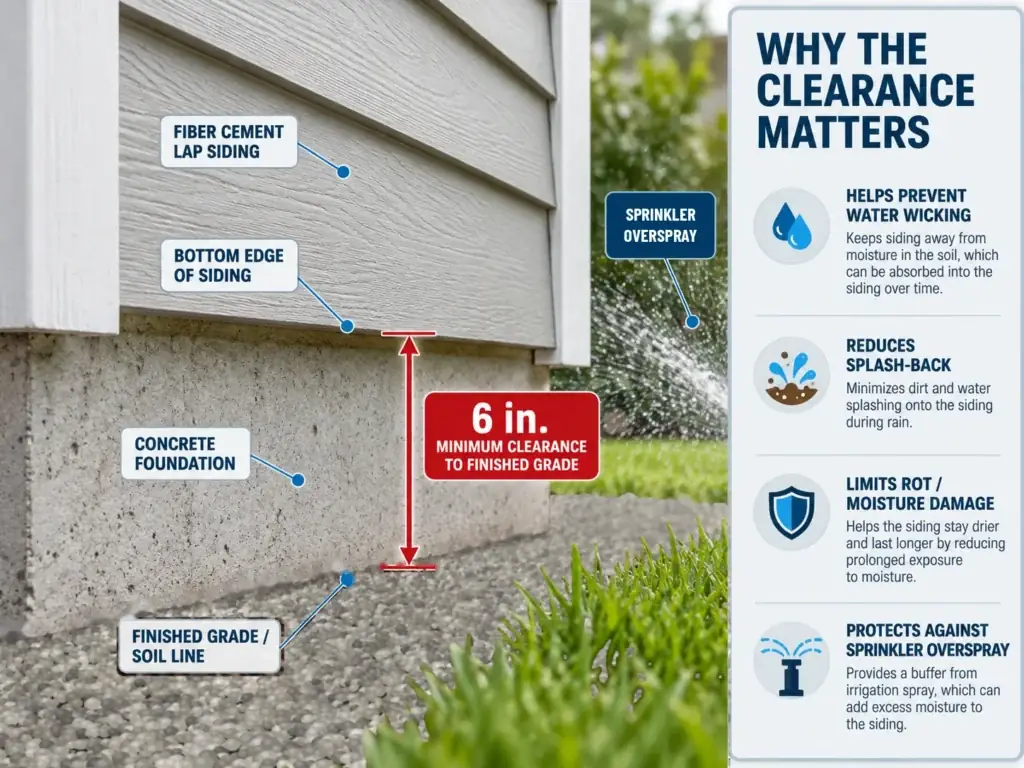
James Hardie requires 6 inches of clearance between fiber cement siding and finished grade, and 1–2 inches above roofs, decks and paved surfaces.
Table D lists 5 James Hardie clearances and the Sacramento condition each one protects against. Values come from the James Hardie HZ10 installation instructions.
Table D. James Hardie fiber cement clearances in Sacramento
| Location | Minimum clearance | Sacramento condition |
|---|---|---|
| Finished grade | 6″ | Sprinkler overspray and wet soil |
| Paths, patios, steps, driveways | 1″–2″ | Splash-back from winter rain |
| Roof-wall intersection | 1″–2″ | Winter roof runoff |
| Above horizontal flashing | 1/4″ | Trapped water behind the bottom edge |
| Roof termination at gutters | Kick-out flashing | Roof water directed into the wall |
Is fiber cement siding nailed or screwed?
Fiber cement siding is blind-nailed into wood framing, and screws are used only for steel framing. James Hardie names blind nailing as the preferred method, with a 2″ siding nail (0.09″ shank) or a 1¼” roofing nail. Face-nailing applies where local high-wind code requires it.
How do installers control silica dust when cutting fiber cement?
Installers control silica dust with 3 James Hardie cutting tiers: score-and-snap or shears (best), a dust-reducing saw with a HEPA vacuum (better), and a dust-reducing saw for low-volume cuts (good). Cal/OSHA’s respirable crystalline silica standard (8 CCR §1532.3, Table 1) covers handheld saws with blades of 8 inches or less cutting fiber-cement board outdoors with a commercially available dust collection system. Indoor cutting falls outside that Table 1 entry. James Hardie prohibits dry sweeping of fiber cement dust.
Can fiber cement siding go over existing siding?
Fiber cement siding goes over an existing wall only when the wall surface is flat and the sheathing is sound. James Hardie limits HardiePlank to flat vertical walls and allows installation over foam sheathing up to 1 inch thick. Old T1-11 and hardboard siding is usually removed to inspect the sheathing, Over stucco, some installers fasten furring strips through sound stucco into the studs; James Hardie does not publish a stucco-specific method, so the assembly is confirmed with James Hardie Technical Services and the building department.
How long does fiber cement siding installation take?
Fiber cement siding installation takes 1–2 weeks for a single-story Sacramento home, based on contractor-reported timelines. Vinyl siding takes 5–7 working days. Plank weight, cutting and dust control add the extra days.
How long does fiber cement siding last in Sacramento?
Fiber cement siding lasts 30–50 years in Sacramento, and James Hardie backs the substrate with a 30-year non-prorated warranty. 5 maintenance tasks extend fiber cement siding life:
- Inspect caulk joints once a year.
- Wash walls with a garden hose, not a pressure washer on high setting.
- Repaint field-painted boards on the interval the paint manufacturer warrants.
- Aim lawn sprinklers away from the bottom course.
- Keep soil and mulch 6 inches below the bottom course.
Localized cracks and swollen boards fall under siding repair in Sacramento. Full tear-off projects fall under siding replacement in Sacramento. Material lifespans are compared in how long siding lasts in Sacramento.
What are the downsides of fiber cement siding?
Fiber cement siding has 5 downsides: higher installed cost, heavy planks, silica dust during cutting, repainting of field-painted boards, and edge swelling when clearances are skipped.
- Installed cost: $12–$22 per square foot, against $6–$13 for vinyl in Sacramento.
- Plank weight: longer installs, 1–2 weeks against 5–7 working days for vinyl.
- Silica dust: cutting requires dust-controlled saws or shears under Cal/OSHA rules.
- Field paint upkeep: primed boards carry no finish warranty from James Hardie.
- Edge swelling: boards touching soil, roofing or decks absorb water at the bottom edge.
How does fiber cement siding compare with vinyl and engineered wood?
Table E compares 3 siding materials installed in Sacramento by cost, lifespan, fire classification, heat behavior and finish.
Table E. Fiber cement, vinyl and engineered wood siding in Sacramento
| Material | Sacramento installed ($/sq ft) | Lifespan | ASTM E136 noncombustible | Heat behavior | Finish |
|---|---|---|---|---|---|
| Vinyl | $6–$13 | 20–40 years | No | Distorts near 160–165°F | Color through the panel |
| Engineered wood | $10–$17 | 20–30 years | No | Stable; edges need sealing | Factory prefinish or field paint |
| Fiber cement | $12–$22 | 30–50 years | Yes | Stable; no softening | ColorPlus or field paint |
Fiber cement siding is the only material of the 3 with a noncombustible classification. Material choices are covered in vinyl siding installation in Sacramento, vinyl vs fiber cement siding and engineered wood siding in Sacramento.
How do you choose a fiber cement siding installer in Sacramento?
There are 7 checks for a fiber cement siding installer in Sacramento:
- Verify the CSLB license, required for jobs of $1,000 or more since AB 2622.
- Confirm workers’ compensation and general liability insurance.
- Check the James Hardie contractor directory if the installer claims Hardie status; the current program is the James Hardie ALLIANCE, with Select, Preferred and Elite tiers.
- Require the product zone (HZ10 or HZ5) and product line on the written quote.
- Ask for the permit path: a building permit plus either the $132 CDD-0185 design-review exemption or full Site Plan and Design Review.
- Request a silica dust plan, plus EPA Lead-Safe certification for pre-1978 homes.
- Compare written labor warranty terms between fiber cement siding contractors.
Contractor vetting is covered in choose a licensed siding contractor in Sacramento.
Get a fiber cement siding estimate in Sacramento
Get a written fiber cement siding quote from Sacramento Siding Pros, serving Sacramento County since 2019. Financing options are available on approved projects.
Fiber cement siding FAQ
How much does James Hardie siding cost in Sacramento?
James Hardie siding costs $12–$22 per square foot installed in Sacramento in 2026. A whole-home re-side costs $30,000–$68,000 or more.
How thick is fiber cement siding?
HardiePlank lap siding is 5/16″ thick, HardieShingle is 1/4″ thick and Artisan siding is 5/8″ thick.
When was fiber cement siding invented?
James Hardie began producing fiber cement in Australia in 1917, switched to cellulose fiber in the mid-1980s and opened its first US plant in 1989.
Where can you buy fiber cement siding in Sacramento?
Lumber dealers and home centers in Sacramento stock primed HardiePlank siding. ColorPlus boards are ordered through James Hardie dealers.
Do you need a permit to install fiber cement siding in Sacramento?
Yes. Siding replacement in the City of Sacramento needs a building permit, and a like-for-like replacement can skip Site Plan and Design Review with the $132 CDD-0185 exemption, except in historic districts. The exemption also allows replacing grooved plywood (T1-11) with cement fiber lap siding; other material changes go through Site Plan and Design Review. Permit rules are covered in Sacramento siding permits.
Can fiber cement siding be painted?
Yes. Fiber cement siding takes 100% acrylic exterior paint. James Hardie excludes stain, oil/alkyd paint and powder coating.
Is fiber cement siding energy-efficient?
Fiber cement siding is not an insulation product. Wall energy savings come from Title 24 cavity insulation (R-13 or R-20) and the water-resistive barrier installed behind the siding.
Why choose fiber cement siding in a Sacramento fire zone?
Fiber cement siding is noncombustible under ASTM E136, and the Safer from Wildfires framework lists fiber-cement siding as an accepted material for the noncombustible bottom 6 inches of exterior walls.
Fiber cement siding installation in Sacramento: summary
Fiber cement siding installation in Sacramento costs $12–$22 per square foot in 2026 and carries a 30-year non-prorated James Hardie substrate warranty. HZ10 product, 6-inch grade clearance and dust-controlled cutting are the 3 installation standards that protect fiber cement siding in Sacramento. Material options and project steps for every siding type are covered in siding installation in Sacramento.
Sources
Costs on this page are calculated by Sacramento Siding Pros from 2026 local installer rates. Code, product and permit facts come from these sources:
- International Code Council. 2025 California Wildland-Urban Interface Code, Title 24 Part 7 (Sections 504.2, 504.5, 504.8 and 504.10).
- James Hardie. HardiePlank Lap Siding Installation Instructions (clearances, fastening and cutting).
- James Hardie. HZ10 product zone and warranty (HZ10 ZIP code coverage).
- Cal/OSHA. 8 CCR §1532.3, Occupational Exposures to Respirable Crystalline Silica (construction cutting controls).
- City of Sacramento. CDD-0185 Exemption from Site Plan and Design Review: Exterior Siding.
- California Department of Insurance. Safer from Wildfires (noncombustible bottom 6 inches of exterior walls).
- Office of the State Fire Marshal. Building Materials Listing (WUI-listed siding products).
- Zonda. 2025 Cost vs. Value Report (fiber cement siding replacement cost recouped).
- Contractors State License Board. Check a contractor license.
- U.S. EPA. Lead Renovation, Repair and Painting Program (pre-1978 homes).